
Hantavirus tracker: why a rare rodent virus is suddenly on the global map
The important thing about hantavirus is not that it is everywhere. It is that when it appears in the wrong place, the story moves faster than the public-health paperwork around it.
That is why the new Hantavirus Tracker is useful. It turns a rare disease story into a map of reported cases, clusters, monitoring signals, and public-health context. It does not replace the CDC, WHO, ECDC, or local health agencies. It gives readers a way to see where the story is, what is confirmed, and which signals still need official interpretation.
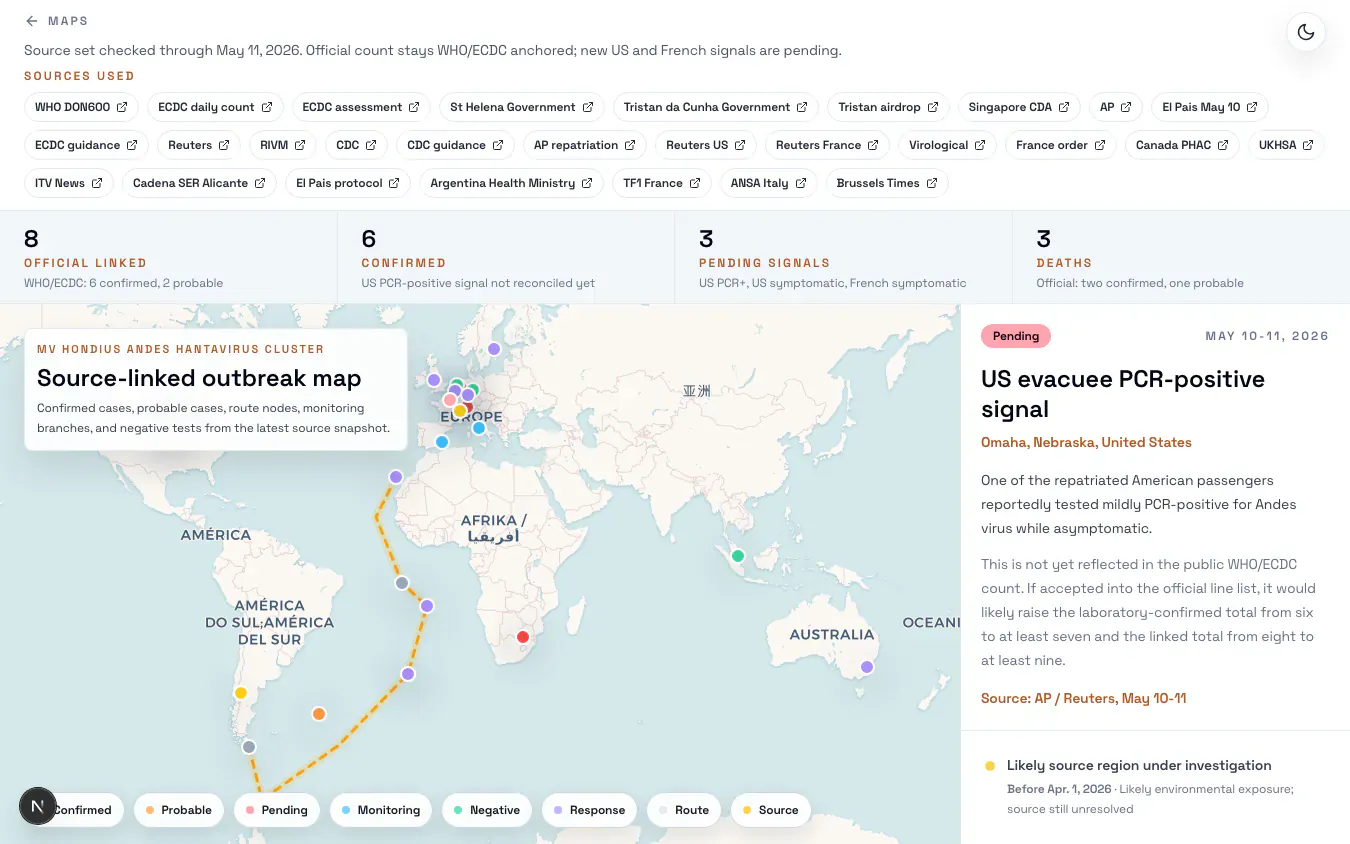
The useful view is not panic. It is geography, dates, source links, and uncertainty in one place.
The short answer
Hantaviruses are a group of rodent-borne viruses. People usually become infected after exposure to urine, droppings, or saliva from infected rodents, often when contaminated dust is disturbed. In the Americas, infection can cause hantavirus pulmonary syndrome, a rare but severe illness that can progress quickly and can be fatal. (CDC)
The reason it is in the news in 2026 is a cruise-ship-linked cluster involving Andes virus, a hantavirus associated with southern South America. As of the May 28 source check, ECDC's latest official aggregate, updated May 26 at 15:00, lists 13 total cases: 11 confirmed, two probable, zero suspected, and three deaths. (ECDC daily)
The increase since the previous tracker update is explained by two quarantine-detected positives, not by unexplained community spread. RIVM reported on May 22 that a Dutch national already in home quarantine tested positive and was moved to hospital isolation as a precaution. Spain reported on May 25 that a second Spanish evacuee tested positive while already quarantined at Gomez Ulla military hospital. (RIVM Dutch) (El Pais Spain) (Reuters Spain)
The U.S. branch should no longer be treated as a confirmed case. CDC's current situation page still says no Andes-virus cases from this outbreak have been confirmed in the United States, and CDC's May 19 update describes additional international cases in France, Spain, and Canada without counting a U.S. confirmed case. The earlier U.S. inconclusive signal belongs in the negative/resolved branch. (CDC situation) (CDC update) (Reuters correction)
Canada is now stable at one confirmed MV Hondius-linked case. PHAC's May 22 update says there have been no additional Canadian cases beyond the initial confirmed British Columbia case and that high-risk contacts remain under monitoring. (Canada May 22)
So far, the most useful non-ship-contact checks still point away from easy casual spread. The latest additions came from known quarantine networks, while public reports still show no confirmed unlinked case outside the ship, passenger, crew, or close-contact network. RIVM's earlier Dutch repatriation and crew testing was negative, France reported contact testing negative, Spanish and Italian contact branches were mostly negative, and the symptomatic passenger sent to Emory tested negative for Andes virus. (RIVM) (France contacts) (El Pais) (Reuters Italy) (CBS Atlanta)
Other new branches are logistics, preparedness, or monitoring, not new epidemiological spread. The Hondius reached Rotterdam, but AP reports its departure was delayed for additional cleaning and final public-health inspection. UKHSA says a previously confirmed British case returned from the Netherlands to England under strict precautions and stressed that this was not a new case. HHS also issued a PREP Act declaration covering Andes-virus/HPS countermeasures, including favipiravir, but that is a legal preparedness framework rather than proof of treatment efficacy. (AP cleaning) (UKHSA) (Federal Register)
That combination is why this story needs a map rather than a shouting headline.
What matters:
- where exposure may have happened
- which cases are confirmed
- which countries are monitoring passengers or contacts
- whether health agencies describe wider public risk as low, elevated, or changing
- whether the virus involved is one with known person-to-person spread risk
The interactive hantavirus map is built for that middle ground: serious enough to watch, too rare and specific to treat as a general public panic.
What is hantavirus?
Hantavirus is not one single virus. It is a family of related viruses carried by rodents in different parts of the world.
Different hantaviruses have different rodent hosts, geography, and disease patterns. In the Americas, the disease most associated with hantavirus is hantavirus pulmonary syndrome, often shortened to HPS. In Europe and Asia, hantaviruses are more often discussed in relation to haemorrhagic fever with renal syndrome, although severity varies by virus. (WHO)
The public often hears the word only during a death, an outbreak investigation, or a warning after rodent exposure. That makes the risk feel sudden. It is usually not sudden in nature. The virus sits in the rodent reservoir. Human cases appear when people cross into contaminated environments: cabins, sheds, farms, campsites, storage rooms, fieldwork sites, or poorly ventilated spaces where rodent droppings have dried and become dust.
That is why hantavirus is such an awkward modern news story. It is not a city-virus narrative. It is an ecology narrative.
The host animal matters. The building matters. The weather matters. The clean-up method matters. A map helps because the disease is tied to place.
Why the 2026 cruise-ship cluster changed the story
Most hantavirus coverage is local. A case in New Mexico. A death in California. A warning after rodent activity in a rural cabin. A seasonal note from a state health department.
The 2026 MV Hondius cluster is different because the exposure story appears international by design. Passengers, crew, evacuation points, ports, and national health systems all enter the same picture.
ECDC said on May 6, 2026, that seven cases had been reported in the cruise-ship cluster, including three deaths. It also said the ship had 149 people onboard, spanning 23 nationalities. (ECDC)
WHO's May 8 Disease Outbreak News update moved the public line list to eight linked cases: six confirmed, two probable, and three deaths. WHO and ECDC's May 13 updates then moved the harmonized official count to 11 total cases, with eight confirmed, two probable, and one inconclusive. Reuters reported on May 15 that WHO revised the count down after the U.S. inconclusive passenger tested negative. Canada then confirmed one MV Hondius-linked case. By May 26, ECDC's table listed 13 total cases: 11 confirmed, two probable, zero suspected, and three deaths. (WHO DON) (Reuters correction) (Canada May 22) (ECDC daily)
Sequencing has also tightened the scientific picture. France's Pasteur Institute fully sequenced the virus from the French passenger and found that it matched known South American Andes-virus lineages, with no evidence so far of new characteristics that would make it more transmissible or more dangerous. AP reports the ship patient viruses were identical to each other and about 97% similar to known South American Andes viruses, including rodent-associated samples. A preliminary Virological analysis reached a similar direction: one zoonotic introduction or very limited related spillovers followed by onboard human-to-human transmission, while still not excluding several passengers infected from the same environmental source. (Pasteur sequencing) (Virological)
That is the practical interpretation: the cluster is sharper, not fundamentally different. New positives are appearing inside the known ship cohort and national quarantine systems. The latest contact branches are mostly monitoring operations, negative results, ship cleaning, or countermeasure preparation, not evidence of sustained spread outside the known exposure network.
This is exactly the sort of event where ordinary readers get lost.
One country reports a suspected case. Another tests returning passengers. A port prepares a response. A ship's route creates dots that look more alarming than the underlying risk. News updates arrive before every lab result has settled.
The tracker matters because it separates map signals:
| Signal type | What it means | How to read it |
|---|---|---|
| Confirmed case | Lab or official confirmation has been reported | High-value signal, but still needs date and place context |
| Cluster | Multiple linked reports around one event or exposure chain | Watch source detail; not every exposed person is infected |
| Monitoring | Health agencies, ports, or countries are watching contacts or passengers | Important context, not proof of infection |
| Public-health context | Official advice, response planning, or risk assessment | Often the best clue for wider public risk |
The map does not make hantavirus more dangerous. It makes the uncertainty visible.
It also filters bad claims. Reuters Fact Check found no evidence for the viral claim that WHO had confirmed 159 cruise-linked hantavirus cases; the official counts remain in the low double digits depending on classification timing. (Reuters fact check)
The risk is severe, but not broad in the usual way
This is the part that gets flattened in bad coverage.
Hantavirus can be deadly. CDC says HPS is fatal in nearly four in ten people who develop it. CDC's US surveillance page reports 890 cases through the end of 2023 and notes that about 94 per cent occurred west of the Mississippi River. (CDC cases)
Those numbers should not be softened. This is a disease where early symptoms can look ordinary, then respiratory distress can develop quickly. Fever, muscle aches, fatigue, nausea, vomiting, diarrhoea, dizziness, and abdominal pain can appear before coughing and shortness of breath. (CDC clinical overview)
But severity is not the same as broad transmissibility.
Most hantavirus infections are not passed from one person to another. The usual route is environmental exposure to infected rodents. CDC says Andes virus is the only type of hantavirus known to spread person-to-person, usually through close contact with an ill person. (CDC transmission)
CDC's May 14 exposure guidance gives the practical frame: the monitoring window is 42 days, person-to-person Andes-virus transmission is relatively rare and generally linked to prolonged close contact, and there is no documented evidence of presymptomatic transmission. (CDC guidance)
That detail is why the MV Hondius story deserves serious attention without being treated like a Covid replay. Andes virus changes the monitoring logic. It is still not a reason to assume runaway community spread. It is a reason to track contacts, routes, testing, and official risk assessments carefully.
The simplest frame:
- rare does not mean harmless
- deadly does not mean easily spread
- low public risk does not mean no operational burden
- a map is useful because the difference lives in the details
Why this is a data story, not just a disease story
Hantavirus is a hard topic for search because readers arrive with different intents.
Some want symptoms. Some want the cruise ship update. Some want to know whether hantavirus spreads between people. Some want a map. Some want to know whether they should clean a garage differently. Some want the latest case count.
Those are not the same question.
A strong tracker page solves one part of the problem: it gives the user a situational layer. The official health pages solve another: they give clinical, prevention, and surveillance context. The article you are reading should sit between them.
Use it like this:
- Start with the source-linked tracker to see geography and reported signals.
- Use WHO or ECDC for the latest international outbreak assessment.
- Use CDC for US symptoms, prevention, cleaning guidance, and surveillance.
- Use local or national health agencies for instructions that apply where you are.
That workflow matters because maps can make every dot feel equal. They are not.
A suspected case, a port-preparedness report, an official fatality, and a news story about monitoring all belong in the same event universe. They do not carry the same weight.
The rodent problem behind the map
Hantavirus is a reminder that public health is not only hospitals and labs. It is also buildings, storage, food, field cabins, ventilation, and ordinary clean-up habits.
CDC's prevention advice is practical. Seal holes. Trap rodents. Remove food sources. Avoid sweeping or vacuuming rodent urine, droppings, or nesting materials in a way that stirs dust. Wet contaminated areas with disinfectant before cleaning. Wear gloves. Ventilate enclosed spaces before entering. (CDC prevention)
That advice is not glamorous, but it is the core intervention for most people.
The economic version is equally plain. Ships, field stations, warehouses, farms, rental cabins, camps, parks, and rural accommodation all carry a version of the same risk question: is rodent control a background maintenance item, or is it treated as a critical safety system?
The answer usually becomes visible only after a case.
That is why a tracker can be useful even when total case numbers are small. Hantavirus events reveal weak points in travel operations, remote-site management, public communications, and the chain between local observation and national reporting.
What to watch now
The main facts to watch are not dramatic.
They are administrative.
For the 2026 cluster, the important updates are:
- whether any additional quarantined passengers or crew test positive before monitoring windows close
- whether the two probable cases are eventually confirmed or ruled out
- whether any non-ship close contact becomes positive
- whether the exact South American source exposure can be identified, including the Ushuaia-linked rodent sampling (Argentina source probe)
- whether the Hondius clears final Rotterdam inspection after additional cleaning
- whether health agencies update risk for passengers, crew, ports, or wider communities
- whether the suspected exposure site is remediated
- whether the case definition changes as testing improves
For wider hantavirus risk, watch different things:
- rodent activity in high-risk buildings
- public-health advisories after wet seasons, floods, or conditions that can shift rodent populations
- local case reports in areas where hantaviruses are known to circulate
- official cleaning guidance for cabins, sheds, barns, and field housing
That makes the tracker most useful as a news and situational-awareness layer, not as a personal risk calculator.
If there is no relevant exposure, the map should not change your day.
If there has been rodent contamination in an enclosed space, the map is less important than CDC cleaning guidance and local medical advice.
How to read the Hantavirus Tracker without overreacting
Good outbreak maps do two things at once. They compress information, and they preserve doubt.
The bad version of a map is a fear machine: dots, red circles, and no hierarchy. The useful version separates confirmed cases from monitoring and context. That is what makes this tracker worth using.
When a new report appears, ask five questions:
- Is it a confirmed infection, a suspected case, or monitoring activity?
- What is the date of the source?
- Which public-health authority is involved?
- Is the location an exposure site, treatment site, port, residence, or reporting jurisdiction?
- Has WHO, ECDC, CDC, or a national agency changed the risk assessment?
That last question is the big one.
Public-health agencies often move more slowly than social feeds, but they also attach definitions to words such as confirmed, probable, contact, exposure, low risk, and public-health emergency. Those definitions matter more than the emotional speed of a feed.
The practical takeaway
Hantavirus deserves attention because it is rare, severe, and easy to misunderstand.
The 2026 cruise-ship cluster shows why. A rodent-borne virus became an international travel story, not because it suddenly behaved like a common respiratory virus, but because exposure, evacuation, nationality, ports, and contact tracing crossed borders.
That is exactly where a tracker helps.
Use the hantavirus map to see the shape of the story. Use official health agencies to decide what the story means.
The right posture is neither panic nor dismissal. It is a disciplined watch: confirm the signal, check the source, understand the route of transmission, and keep the risk in proportion.
FAQ
Where can I see a hantavirus map?
The Hantavirus Tracker gives a map-first view of confirmed cases, clusters, monitoring signals, and public-health context. Use it as a starting layer, then confirm health guidance with CDC, WHO, ECDC, or local agencies.
Is hantavirus contagious between people?
Most hantaviruses are not known to spread from person to person. CDC says person-to-person spread has been reported only in Chile and Argentina with Andes virus. That is why an Andes-virus-linked cluster gets closer monitoring than many other hantavirus reports.
How do people get hantavirus?
Most infections happen after exposure to infected rodent urine, droppings, or saliva, especially when contaminated dust is disturbed in enclosed or poorly ventilated spaces.
What are early hantavirus symptoms?
Early symptoms can include fever, fatigue, muscle aches, dizziness, chills, nausea, vomiting, diarrhoea, and abdominal pain. Later symptoms can include coughing and shortness of breath. Anyone worried about exposure or symptoms should contact a medical professional or local health authority.
Is the 2026 cruise ship outbreak a public risk?
WHO assessed the global public-health risk as low in its May 13, 2026 Disease Outbreak News update, while considering risk for people who were onboard moderate. ECDC's May 26 page still assesses risk to the EU/EEA general population as very low. The May 28 source check shows 13 linked cases, two recent quarantine detections, and contact management, but not sustained spread outside the known exposure network.
How can hantavirus risk be reduced?
The main prevention steps are rodent control and safe clean-up: seal entry points, remove food sources, trap rodents, ventilate closed spaces, wet contaminated areas with disinfectant before cleaning, and avoid stirring up dust from droppings or nests.