
The Historical Borders Map That Makes Every Country Look Temporary
Open a historical borders map and pick a place you think you know.
Do not start with the famous empires. Start with home.
Drag from today to 1914. Then to 1500. Then to 1000.
The country becomes a frame in a film. The line you grew up treating as natural starts to look like an agreement, an inheritance, a memory, sometimes a wound.
That is the trick. Countries feel permanent because most people are handed one screenshot of the map and told it is the world.
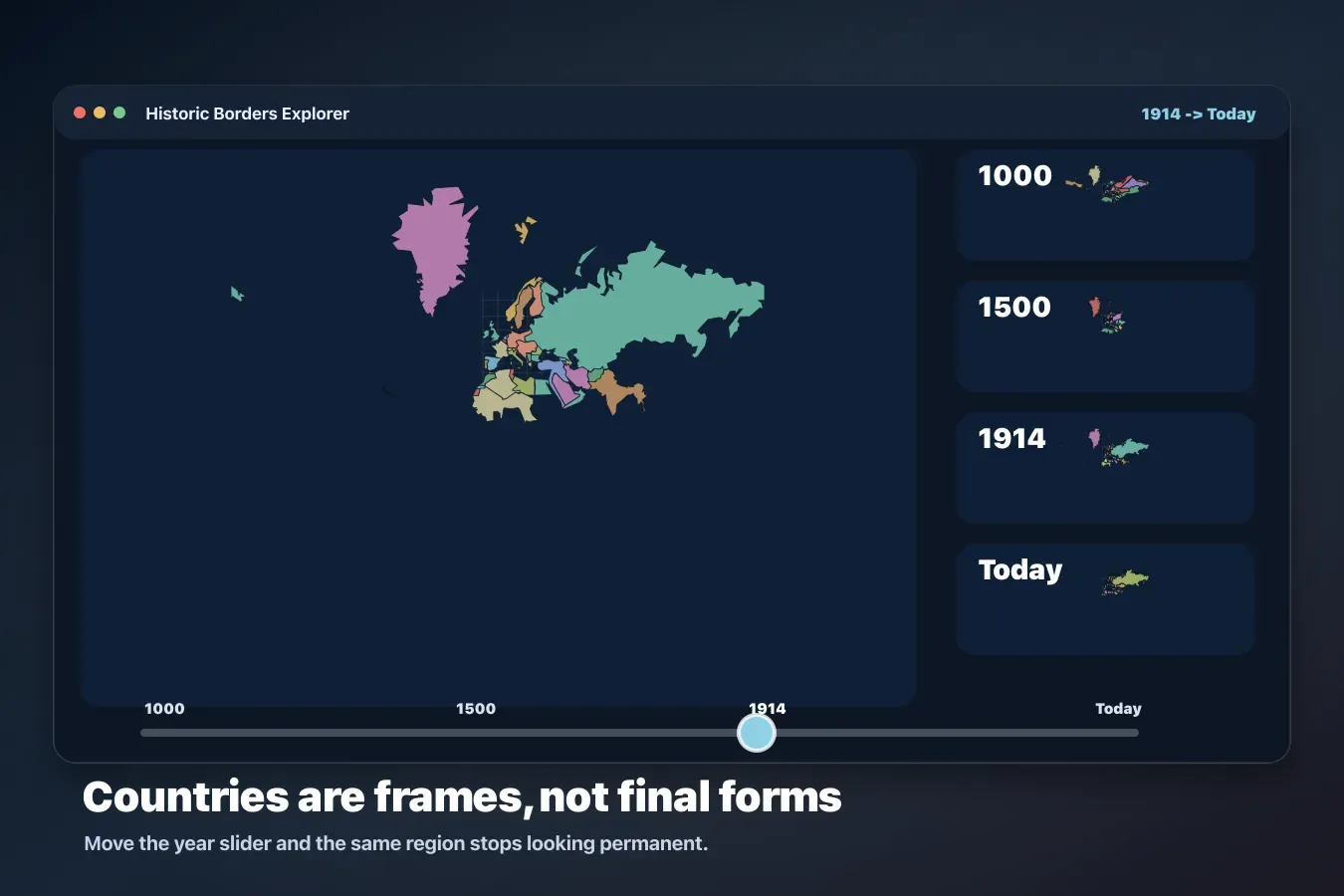
A country can look permanent in one frame and temporary in a timeline.
Quick answer: why do borders feel permanent?
Borders feel permanent because the modern world repeats the same map everywhere: schools, passports, news graphics, phone apps, shipping forms, country-code databases, sports tournaments, and weather maps.
But a border is not a geological feature. It is a system.
It can be produced by war, treaty, survey, empire, decolonization, occupation, federation, collapse, recognition, or database convention. The modern international system strongly protects territorial integrity, which makes borders harder to revise by force, but that does not make them timeless. The UN Charter, for example, tells member states to refrain from using force against the territorial integrity or political independence of any state. (United Nations Legal Affairs)
That is why the Historical Borders Map works so well as a first article in this series. It does not just show old borders. It changes the emotional status of the present.
The map stops being a wall.
It becomes a timestamp.
Why a historical borders map changes how the world feels
A normal political map is designed to hide time.
It shows one arrangement: today's countries, today's names, today's colors, today's assumption that the lines belong where they are. That is useful. You need a stable map to teach geography, route packages, issue passports, run elections, and explain the news.
But that same usefulness creates a quiet illusion.
When the same border appears in every classroom, search result, customs form, sports broadcast, and phone dropdown, it starts to feel older than it is. A country begins to look like a mountain range. A capital looks inevitable. A frontier looks as if it has always been waiting there.
A historical borders map breaks that illusion by adding the missing variable: time.
The interactive historical borders timeline is especially good for this because it turns political geography into motion across the available snapshots. You can watch states appear, split, merge, shrink, expand, vanish, and sometimes return under new names. The point is not that every change is equally important. The point is that the current frame is not the whole film.
OpenHistoricalMap, one of the serious starting points for this kind of work, describes itself as an interactive map of the world throughout history, built by contributors and dedicated to the public domain. (OpenHistoricalMap) CShapes, a more formal political science dataset, maps independent states and dependent territories from 1886 to 2019, with Europe going back to 1816. (International Conflict Research)
Those two projects do different jobs. One is a public historical mapping project. The other is a structured academic dataset. Both reveal the same basic fact: borders are data with dates.
What counts as a country on a historical borders map?
This is where the easy version of the story breaks.
A map can label a polygon as a country, but "country" is not one simple category. It can mean a sovereign state, a nation, a dependency, a recognized member of an international organization, a territory controlled on the ground, or a familiar name used by ordinary people.
For legal statehood, the classic reference is the 1933 Montevideo Convention. It says a state should have a permanent population, a defined territory, a government, and the capacity to enter relations with other states. (Avalon Project) That sounds clean until you try to map the real world.
What about a place with de facto control but limited recognition?
What about a government in exile?
What about a colony?
What about a frontier where authority fades rather than stops?
What about an empire with provinces, vassals, protectorates, tribute relationships, chartered companies, military zones, and local rulers who still matter?
A good historical borders map has to make choices.
Here is the practical vocabulary.
State
A state is a political entity with institutions, territory, population, and external relations. In modern law, this is the closest category to a sovereign country.
Empire
An empire is not just "a big country." It is a layered system of rule across different peoples, regions, legal statuses, and degrees of control. On a map, empires often look cleaner than they were.
Colony or dependent territory
A colony or dependent territory is governed under the authority of another state. The UN Charter's Chapter XI deals with territories whose peoples had not yet attained a full measure of self-government. (United Nations Legal Affairs) The UN reported in 2026 that more than 80 former colonies have gained independence since 1945, while 17 non-self-governing territories remain on its list. (The United Nations Office at Geneva)
Occupation zone
An occupation zone is controlled by an outside military or power arrangement, often after war. It is not automatically the same thing as a new sovereign border. Germany after World War II is the classic visual example: Allied documents divided Germany and Berlin into zones of occupation. (German History in Documents and Images)
Frontier
A frontier is a zone, not always a line. This matters most before modern surveying and centralized administration. A crisp border on a 1000 or 1500 map can make the past look more bureaucratic than it was.
That is why the companion guide on how historic border maps are created and where they are limited matters. The map is not magic. It is an argument made with sources, geometry, labels, and humility.
The years that break the illusion
Some years are more visually explosive than others.
Not because all history turns on neat dates. It does not. But because certain map frames expose the machinery.
1000: the world before the country-shaped mind
The year 1000 is useful because it frustrates modern expectations.
You are looking at kingdoms, empires, caliphates, principalities, dynastic zones, frontier belts, and regions where authority overlaps. Many familiar countries do not exist in their modern form. Many familiar names are missing, displaced, or attached to something else.
This is the first lesson: absence on a state map is not absence of people.
A historical borders map of 1000 can be powerful, but it must be read carefully. The clean line is often a modern way of representing a messy historical reality.
1500: empires, kingdoms, and the beginning of global shock
The year 1500 is visually useful because it catches the world at a hinge.
In Europe, dynastic states and empires are shifting. Around the Mediterranean, the Ottoman Empire is a major force. Across the Atlantic, European maritime empires are beginning to transform global history, but much of that transformation is still ahead.
The trap is to treat 1500 as a "before" picture where the rest of the world waits for Europe. That is false. The Americas, Africa, Asia, and Oceania were full of political systems, cities, trade networks, confederations, empires, and local sovereignties that do not always fit modern country polygons.
A good map should make you curious, not lazy.
1815: the restoration map
The year 1815 is one of the cleanest shock frames for Europe.
The Congress of Vienna reorganized much of Europe after the Napoleonic Wars and completed its Final Act in June 1815. Britannica notes that it settled many frontiers north of the Alps and laid foundations for the settlement of Italy, while also noting that "the congress" as a single representative body of all Europe never actually met in the simple way people imagine. (Encyclopedia Britannica)
That is a perfect border-map lesson.
Even the famous diplomatic moments are messier than the classroom version.
1914 and 1918: the empire frame and the aftershock
1914 is one of the best years for making the modern map feel strange.
Europe before World War I was not a continent of today's familiar states. It included the German Empire, Austria-Hungary, the Russian Empire, and the Ottoman Empire. The global picture was even more imperial because European powers controlled huge colonial territories.
The National WWI Museum's global map emphasizes that the war drew soldiers, supplies, and labor from colonies and commonwealths and spread far beyond the Western Front. (National WWI Museum and Memorial)
Then look at 1918.
The map does not simply "update." It fractures. New states appear. Empires collapse or are transformed. Borders that seem familiar begin to emerge, but not in their final form. A World History Commons map of Europe in 1918 shows prewar borders in black and new states in red, making the postwar change visible at a glance. (World History Commons)
1914 says: this world was not long ago.
1918 says: and it did not survive.
1945: the year the map becomes institutional
1945 is not just another border frame. It is a system reset.
World War II ends. Germany is divided into occupation zones. The United Nations is founded. Decolonization accelerates in the decades that follow. The Cold War turns borders, occupation lines, alliance systems, and ideological divisions into a global structure.
This is when the map begins to look more like the institutional world many people recognize: international law, member states, development agencies, security councils, peacekeeping, passports, standardized country names, and statistical systems.
But even here, the map is not final. It is just more bureaucratic.
1991: the modern map glitches
1991 is the year that proves recent does not mean stable.
The Soviet Union dissolved, and 15 independent countries replaced it. (Encyclopedia Britannica) The United States State Department's historical summary notes that, in late 1991, recognition questions centered on principles such as existing borders, democracy, human rights, and respect for international law. (Office of the Historian)
For readers born after 1991, this can feel like ancient history. It is not.
Many people alive today learned one world map in school and watched another one arrive.
Today: not the final frame
Today feels stable because we live inside it.
There are 193 UN member states. (United Nations) ISO country codes help databases treat countries and subdivisions as standardized units. (ISO) Natural Earth, a widely used cartographic dataset, has to decide whether to show de facto boundaries, de jure claims, disputed regions, and point-of-view variants. (Natural Earth)
That is the hidden system behind the simple map.
Every "today" map is still making choices.
The four-panel visual: 1000, 1500, 1914, today
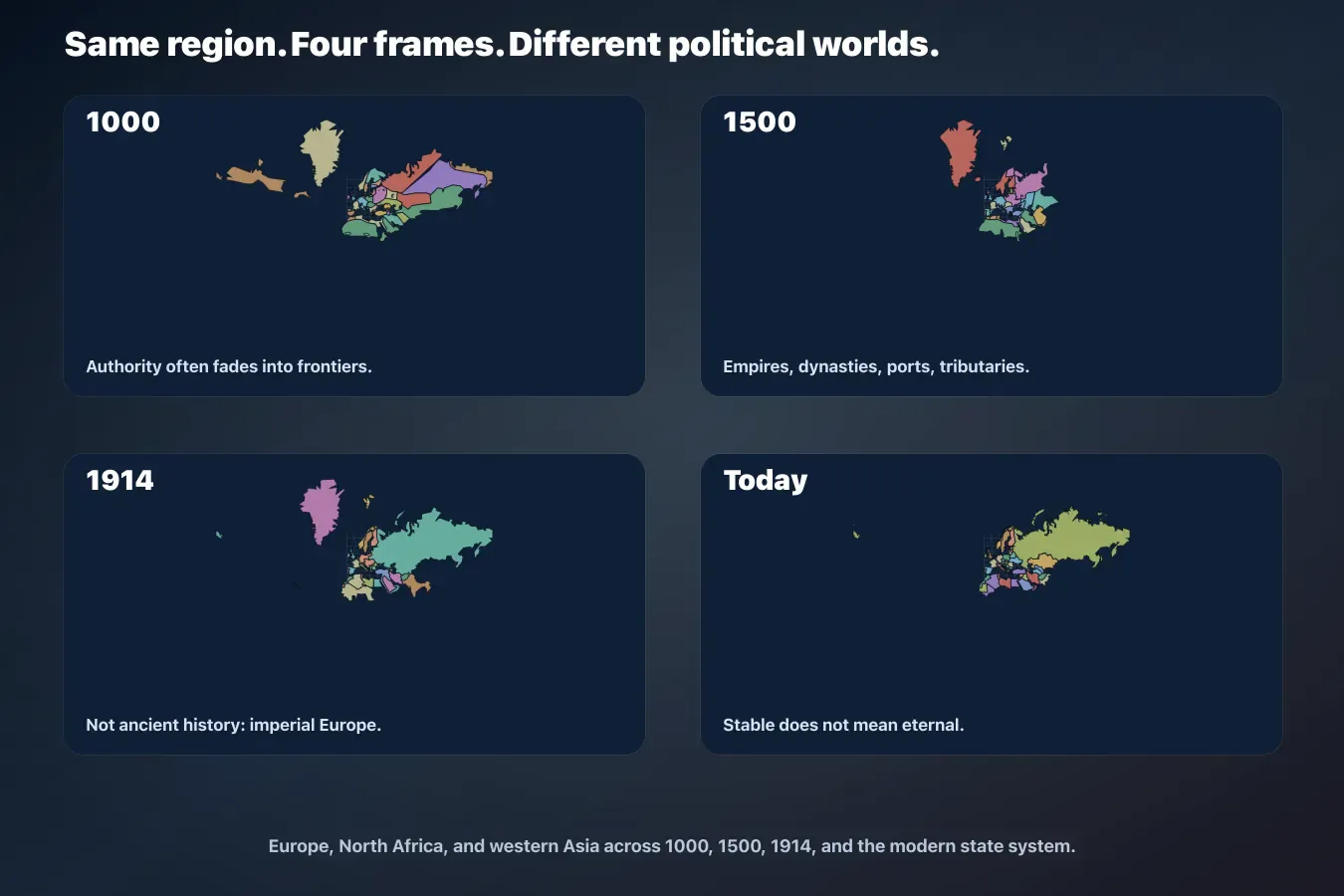
The same region across four frames: 1000, 1500, 1914, and today. The shock is not one border changing. It is the whole category system changing.
For the launch image, use the same region in four panels: Europe, North Africa, and western Asia.
That region works because it makes the transformation obvious without needing a history lecture.
Panel 1: 1000 Show a world of kingdoms, empires, caliphates, and frontier zones. Add a small label: "Many borders approximate authority, not modern sovereignty."
Panel 2: 1500 Show the late medieval and early modern hinge: Ottoman power, Iberian kingdoms, dynastic Europe, and the beginning of Atlantic empire. Add: "Do not read blank space as empty space."
Panel 3: 1914 Show imperial Europe before World War I: Germany, Austria-Hungary, Russia, the Ottoman Empire, and colonial connections beyond the frame. Add: "This is not ancient history."
Panel 4: 2023 dataset frame Show the latest state-system frame available in this explorer. Add: "Stable does not mean eternal."
Then add the most important button on the page:
Try your own place: start with the 2023 map, search for a region you know, then compare the same place in 1914, 1500, 1492, and 1000.
How to explain uncertainty without killing the drama
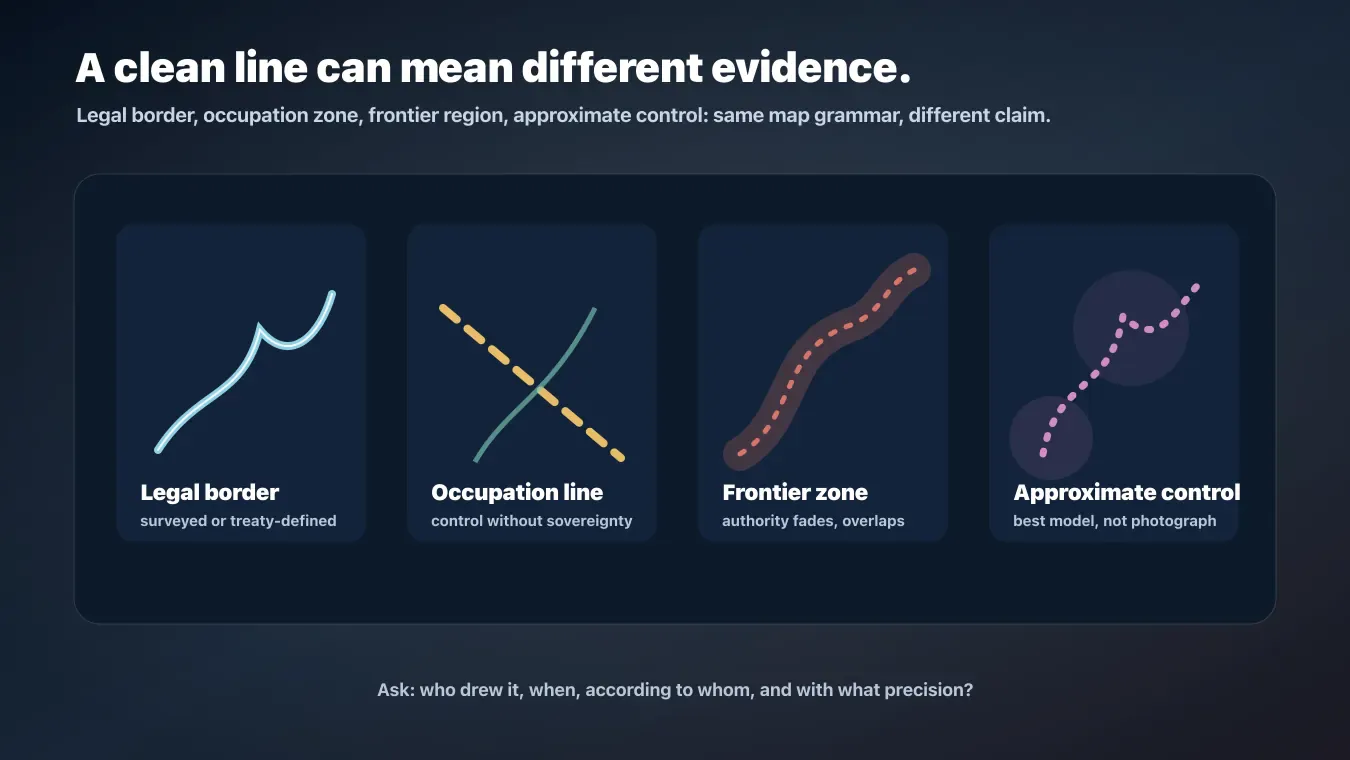
A clean line can represent very different kinds of historical evidence.
The drama of a historical borders map does not require fake precision.
In fact, uncertainty makes the map better.
The honest version is this: a border map is a visual model of political geography at a chosen date. For recent periods, the evidence may be strong: treaties, surveys, administrative records, official maps, and datasets. For older periods, the evidence can be thinner, regional, disputed, or incompatible with modern borders.
The historical-basemaps project states this directly. It calls itself a work in progress, recommends verification before academic use, and includes a border precision field ranging from approximate to legally determined. It also warns that historical boundaries are often more disputed than contemporary ones and that old vector maps over modern basemaps can imply false precision. (GitHub)
That should not weaken the article.
It should sharpen it.
A clean map says: "Here is the answer."
A good historical map says: "Here is the best representation we can make, and here is where the representation starts to bend."
That is more interesting. It teaches readers to ask better questions.
Who drew this line?
At what date?
According to whom?
Was it claimed, controlled, recognized, surveyed, occupied, inherited, or imagined?
Once a reader starts asking those questions, the map has done its job.
What to do in the Historic Borders Explorer after reading
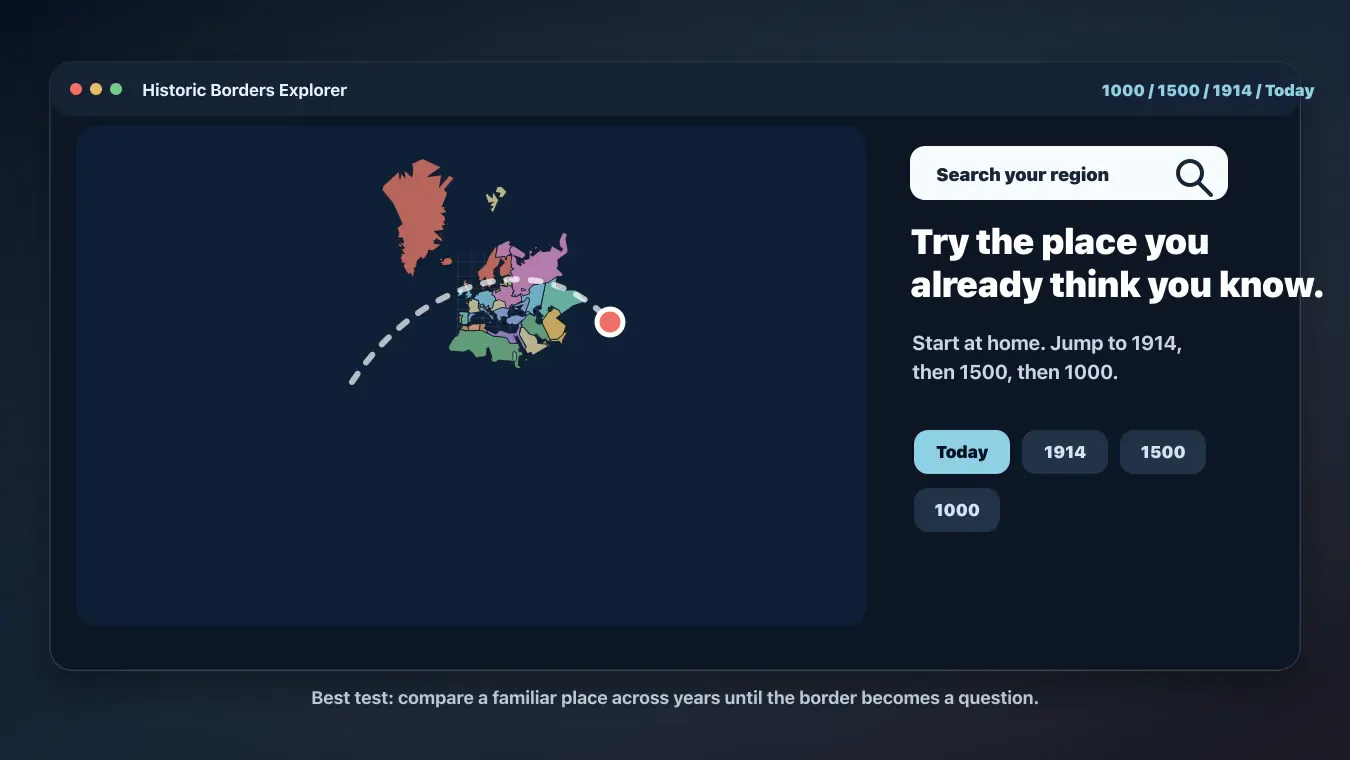
The best place to test the map is the place you already think you understand.
Use the explorer like a microscope, not a trivia toy.
Start with a place you know well. Your city. Your border region. Your ancestral province. A country you think of as obvious.
Then do this:
- Open the Historical Borders Map.
- Search or zoom to your region.
- Set the map to 2023, the latest dataset frame. Take a mental snapshot.
- Jump to 1914. Ask what names disappeared.
- Jump to 1500. Ask whether the map still uses categories that feel familiar.
- Jump to 1000. Ask where the line becomes a guess, a frontier, or a simplification.
- Use timeline playback when you want to move through every available snapshot in sequence.
- Compare the result with other interactive maps and browser tools if you want a wider view of how interfaces shape what people notice.
Do not look only for countries that vanished.
Look for the hidden systems: empires, protectorates, occupations, colonies, unions, federations, breakaway regions, border corrections, and places that refuse to fit one label.
That is where the map gets interesting.
The point is not that countries are fake
This is the bad viral version of the argument: "Borders are made up, therefore they do not matter."
No.
Borders are made by people, and that is exactly why they matter.
They decide who can vote, where law changes, which army is responsible, which passport opens a gate, which school curriculum gets taught, which statistics count you, which side of a war you are trapped on, and which government claims the right to tax, protect, or ignore you.
A historical borders map does not make countries meaningless.
It makes them legible.
It shows that the present map is not a natural fact. It is a political arrangement with a history, a maintenance cost, and a future.
The current world map is not a lie.
It is not destiny either.
It is today's frame.
FAQ: historical borders maps
What is a historical borders map?
A historical borders map shows political boundaries at different points in time. Good versions let you compare years, zoom into regions, and see how states, empires, colonies, occupation zones, and disputed areas changed.
Why do old borders look so precise?
Because digital maps need geometry. A GIS map has to draw lines and polygons even when historical authority was fuzzy. For older periods, treat the line as a model, not a surveyed fact.
What is the difference between a country and a state?
In casual speech, "country" is broad. In legal and political contexts, a "state" usually means an entity with territory, population, government, and capacity for relations with other states. The Montevideo Convention is the standard reference for that formulation. (Avalon Project)
Is a UN member state the same thing as a country?
Not exactly. The UN has 193 member states, but membership is not the only possible way people use the word "country." Some territories, dependencies, partially recognized states, and disputed regions do not fit neatly into that count. (United Nations)
Why use 1000, 1500, 1914, and today?
Because they create contrast. 1000 challenges the modern country-shaped imagination. 1500 shows early modern transition and the beginning of global imperial change. 1914 shows a world of empires just before World War I. Today shows the state system readers take for granted.
Can teachers use the Historic Borders Explorer?
Yes, with caveats. It is excellent for visual comparison, discussion, and historical curiosity. For exams, academic claims, or sensitive disputes, pair it with primary sources, atlases, academic datasets, and the guide on how historic border maps are created and where they are limited.
Does a historical map prove who owns a place?
No. It can show claims, control, administration, occupation, recognition, or historical interpretation. Ownership and legitimacy are legal and political questions that a map alone cannot settle.
The map is temporary. The habit is not.
The first time you drag the year slider, the shock is visual.
The second time, it becomes methodological.
You stop asking, "Where is the border?"
You start asking, "What kind of border is this?"
That is the better question.
Because every country on the map is doing two things at once. It is acting permanent enough to run schools, courts, roads, armies, currencies, archives, and elections. And it is sitting inside history, where even the most confident line can become a footnote.
A border is not just a line.
It is a timestamp with guards.