
Current Country Border Disputes in 2026: A Global Guide
The world map looks finished because it is printed that way.
One color per country. One clean line between neighbors. One label for each capital. School atlases, passports, phone country pickers, delivery forms, weather apps and news graphics all repeat the same visual grammar: the country exists here, the next country starts there.
That is useful. It is also misleading.
As of June 18, 2026, dozens of borders, islands, sea boundaries and occupied territories are still disputed. Some are active war zones. Some are managed by UN peacekeepers. Some are before the International Court of Justice. Some are quiet enough that tourists barely notice them. Some are so politically frozen that the line on the map has become a substitute for settlement.
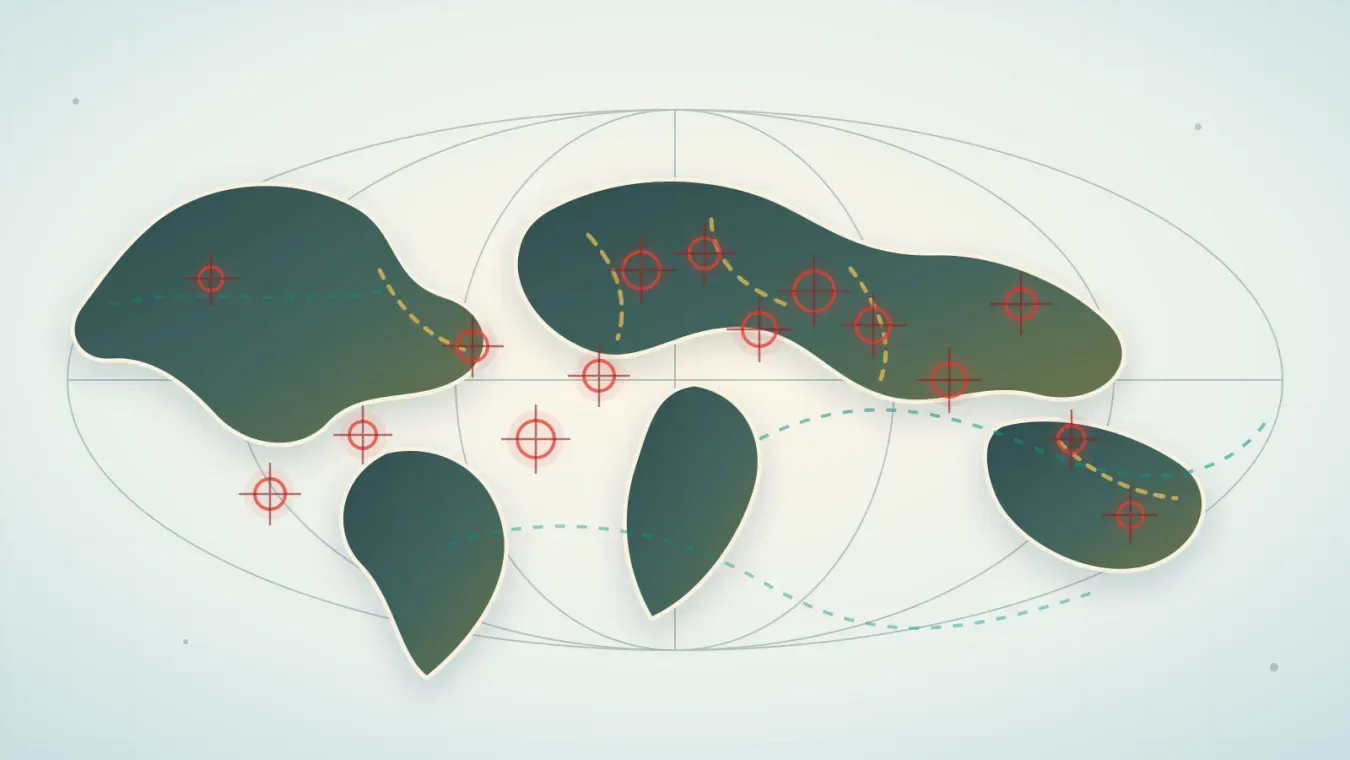
A modern political map looks fixed until you ask which lines are still being argued over.
This guide is the broad inventory. It covers country-to-country border disputes, territorial sovereignty claims, contested islands, disputed maritime boundaries and de facto dividing lines where the legal border and control on the ground do not match.
For the narrower question of which borders have actually changed since 2000, see the companion guide to all country border changes in the 21st century.
For historical context, the explorer's latest dataset frame is the 2023 world map. Compare it with 1945, 1960, and 1994 to see how postwar settlement, decolonization, and state succession shaped the present baseline. The explorer does not adjudicate the 2026 claims below or show live control lines.
It does not treat every separatist movement as an international border dispute. It also does not pretend that every claim is equally strong. A UN-monitored ceasefire line, an ICJ case, a frozen colonial claim and a domestic nationalist slogan are not the same thing.
But they all reveal the same fact: the political map is not a natural object. It is a settlement. And many settlements are still unfinished.
The short answer
The most important disputed country borders in 2026 fall into seven groups:
- War and occupation disputes: Russia-Ukraine, Israel-Palestine, Israel-Syria, Georgia-Russia, Armenia-Azerbaijan, Sudan-South Sudan, India-Pakistan, India-China and Thailand-Cambodia.
- UN-monitored or UN-linked disputes: Kashmir, Cyprus, Western Sahara, Abyei, Golan, Lebanon-Israel, Kosovo and the occupied Palestinian territory.
- International court disputes: Guyana-Venezuela over Essequibo, Guatemala-Belize, Belize-Honduras over the Sapodilla Cayes, and recently decided cases such as Gabon-Equatorial Guinea.
- High-stakes maritime disputes: the South China Sea, the Aegean and Eastern Mediterranean, Sir Creek, the Beaufort Sea, the Gulf of Fonseca and parts of the Caribbean.
- Island sovereignty disputes: Senkaku/Diaoyu, Dokdo/Takeshima, the Kurils/Northern Territories, Abu Musa and the Tunbs, Falklands/Malvinas, Gibraltar, Mayotte, the Scattered Islands, Chagos, Matthew and Hunter Islands, Minerva Reefs and others.
- Frozen or low-temperature border disputes: US-Canada, Guyana-Suriname, Chile-Argentina, Slovenia-Croatia, Croatia-Serbia, India-Nepal, China-Bhutan, Malawi-Tanzania, Burkina Faso-Benin and more.
- Recently settled or legally decided disputes that still matter politically: Kyrgyzstan-Tajikistan, Somalia-Kenya, Nicaragua-Colombia, Costa Rica-Nicaragua, Gabon-Equatorial Guinea, Cameroon-Nigeria and several older ICJ or arbitral decisions.
That last group matters because "disputed" is not a permanent legal status. Some disputes move from war to negotiation, from negotiation to court, from court to implementation, and from implementation to political resentment.
What counts as a disputed border?
The useful definition is wider than a line on land.
A disputed border can be:
- a land boundary that two states draw differently
- a territory occupied by one state and claimed by another
- a de facto line of control that is not accepted as the legal border
- an island or reef whose sovereignty is contested
- a maritime boundary affecting exclusive economic zones, seabed rights or territorial waters
- a colonial or non-self-governing territory claimed by a neighboring state
- an international frontier accepted in principle but not fully delimited or demarcated on the ground
That is why a serious list cannot include only land borders. Modern borders run through rivers, glaciers, deserts, islands, reefs, seabeds, airspace and military buffer zones.
It is also why the strongest source base is mixed. The United Nations Peacekeeping list shows where international missions are still deployed, including Western Sahara, Golan, Cyprus, Abyei, Kosovo, Lebanon and India-Pakistan. (UN Peacekeeping) ICJ pages show which disputes have reached the world court. National foreign ministries show official state positions. Court awards and arbitration records show which arguments have already been tested.
No single public institution maintains a perfect live list of every disputed border in the world. The list below is therefore an editorial inventory, not a court judgment.
Active war, occupation and militarized border disputes
These are the disputes where the border is not just a diplomatic argument. Control, troops, ceasefire lines or war shape the map every day.
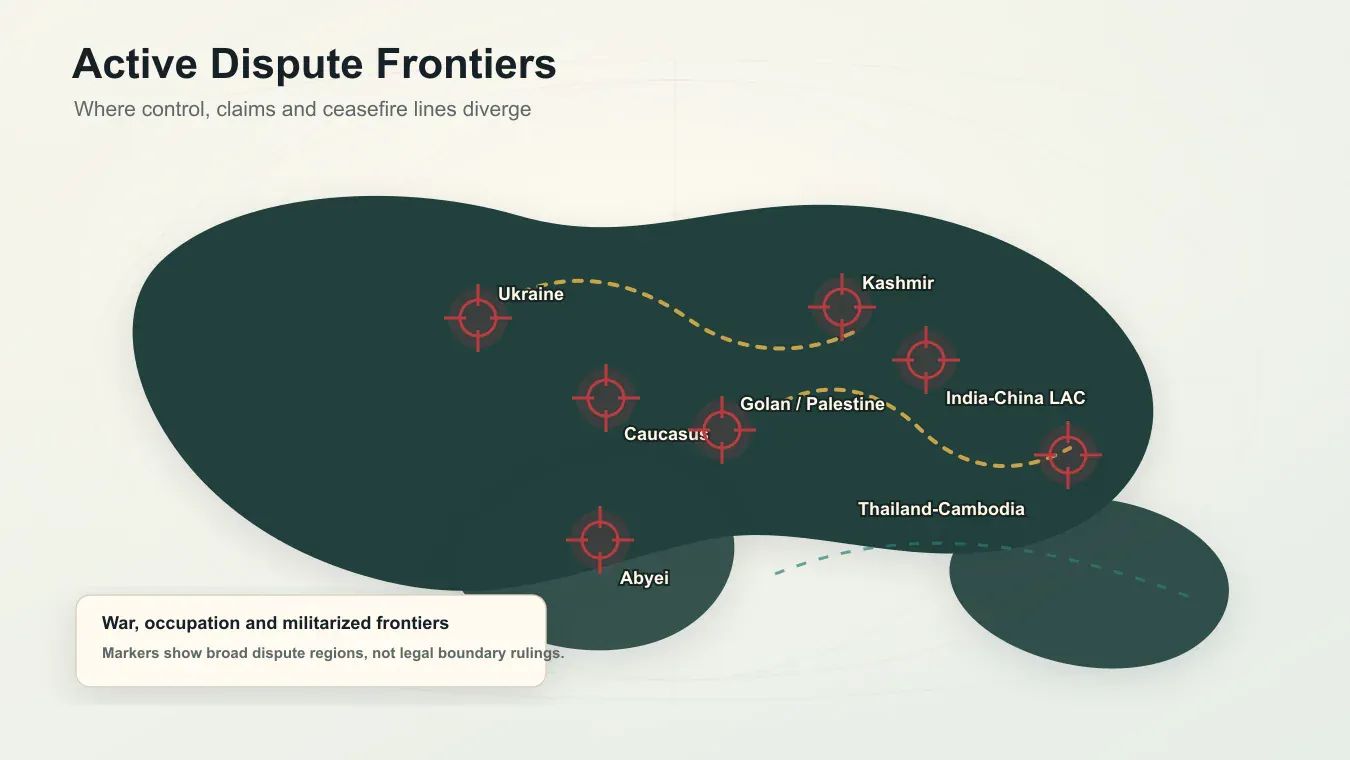
The most dangerous disputes are not only lines on paper; they are fronts, patrol zones and ceasefire boundaries.
Russia and Ukraine
The Russia-Ukraine dispute is the clearest example of a border dispute becoming a system-wide challenge to the modern territorial order.
Russia occupies and claims Crimea and parts of Donetsk, Luhansk, Zaporizhzhia and Kherson. Ukraine claims all of those territories within its internationally recognized borders. The UN General Assembly resolution on the attempted annexation of Ukrainian regions rejected those changes and defended Ukraine's territorial integrity under the UN Charter. (UN Digital Library)
This is not a technical demarcation dispute. It is a war over whether territory can be taken by force and then normalized by paperwork.

In active disputes, the practical border is often a roadblock or control point before it is a treaty line.
India and Pakistan: Kashmir, Siachen and Sir Creek
Kashmir remains one of the world's most consequential disputed borders. The UN Military Observer Group in India and Pakistan says Jammu and Kashmir was left in dispute after the 1947 partition, and UN observers have been connected to the ceasefire line since 1949. (UNMOGIP) The 1972 Simla Agreement created the Line of Control, but India and Pakistan still disagree over UNMOGIP's continuing role. (UNMOGIP background)
Three layers matter:
- Jammu and Kashmir's final status
- the Siachen Glacier and the Actual Ground Position Line
- Sir Creek, a tidal estuary whose land endpoint affects maritime claims in the Arabian Sea
That combination makes the India-Pakistan frontier both a land dispute and a maritime dispute.
India and China
The India-China border is not fully delimited. The Line of Actual Control separates areas under each side's control, but the two governments do not share one agreed map of that line.
The major sectors are:
- Aksai Chin and Ladakh in the western sector
- middle-sector Himalayan areas around Himachal Pradesh and Uttarakhand
- Arunachal Pradesh, which China refers to as Zangnan or South Tibet and India treats as an integral state
India's Ministry of External Affairs said India and China reached 2024 patrolling arrangements for Depsang and Demchok along the Line of Actual Control, which shows the dispute is managed through sector-specific agreements rather than a final boundary settlement. (India MEA)
Israel, Palestine, Syria and Lebanon
The eastern Mediterranean has several overlapping border and territorial disputes:
- Israel-Palestine: the West Bank, including East Jerusalem, and Gaza remain central to the unresolved Israeli-Palestinian territorial question. The ICJ's 2024 advisory proceeding addressed the occupied Palestinian territory, including East Jerusalem. (ICJ Palestine advisory)
- Israel-Syria: Israel controls the Golan Heights; UNDOF supervises the 1974 disengagement arrangement between Israeli and Syrian forces. (UNDOF)
- Israel-Lebanon: the Blue Line is not a final border. Shebaa Farms, Ghajar and other points remain politically sensitive, even after the 2022 maritime deal reduced one layer of dispute.
These are not one dispute. They are several disputes that touch the same regional security architecture.
Armenia and Azerbaijan
After Azerbaijan regained control over Nagorno-Karabakh, the core international issue shifted from the former Karabakh front line to the Armenia-Azerbaijan state border, enclaves, transit routes and demarcation.
The two states have moved toward a peace agreement, and border commissions continue work. But until the full border is delimited, demarcated and accepted locally, this remains an active frontier dispute rather than a finished settlement.
That distinction matters. A peace text can end one war while leaving the map work unfinished.
Georgia and Russia: Abkhazia and South Ossetia
Georgia claims Abkhazia and South Ossetia as part of its territory. Russia recognizes both as independent and maintains decisive influence there. The European Union Monitoring Mission patrols areas adjacent to the Administrative Boundary Lines separating the breakaway regions from Georgian-administered territory. (EUMM Georgia)
The phrase "Administrative Boundary Line" is important. It describes a de facto line on the ground without accepting it as an international border.
Cyprus
Cyprus is divided between the internationally recognized Republic of Cyprus in the south and the Turkish-controlled north, recognized only by Turkey as the Turkish Republic of Northern Cyprus. UNFICYP works across the buffer zone to prevent tension and support conditions for a settlement. (UNFICYP)
Cyprus is a reminder that a disputed border can run through city streets, property deeds, checkpoints, water systems and family histories.
Sudan and South Sudan: Abyei and other border areas
Abyei is one of the most explicit disputed territories in the world. UNISFA describes its mission as providing security and stability in the disputed territory while supporting dialogue on long-term peace. (UNISFA) The UN Security Council was still being briefed in 2026 on how conflict and political uncertainty were delaying agreement on Abyei's final status. (UN Press)
The wider Sudan-South Sudan border also includes unresolved areas and implementation problems, including Kafia Kingi and parts of the oil-region frontier.
Afghanistan and Pakistan
Pakistan treats the Durand Line as the international border. Afghan governments, including Taliban authorities, have historically rejected or contested that settlement. The dispute is sharpened by cross-border militancy, refugee movement, fencing, tribal geography and periodic clashes.
This is a classic case where a colonial-era line became a modern security frontier without becoming a fully accepted political settlement.
Thailand and Cambodia
The ICJ ruled in 1962 that the Temple of Preah Vihear belongs to Cambodia, and issued a later interpretation in 2013. (ICJ Preah Vihear) But some surrounding border sectors and temple-adjacent areas have continued to produce military tension.
This is what happens when a court settles one object clearly but the wider frontier remains politically charged.
The big maritime disputes hidden by normal maps
Most people imagine borders as land lines. States increasingly fight over water.
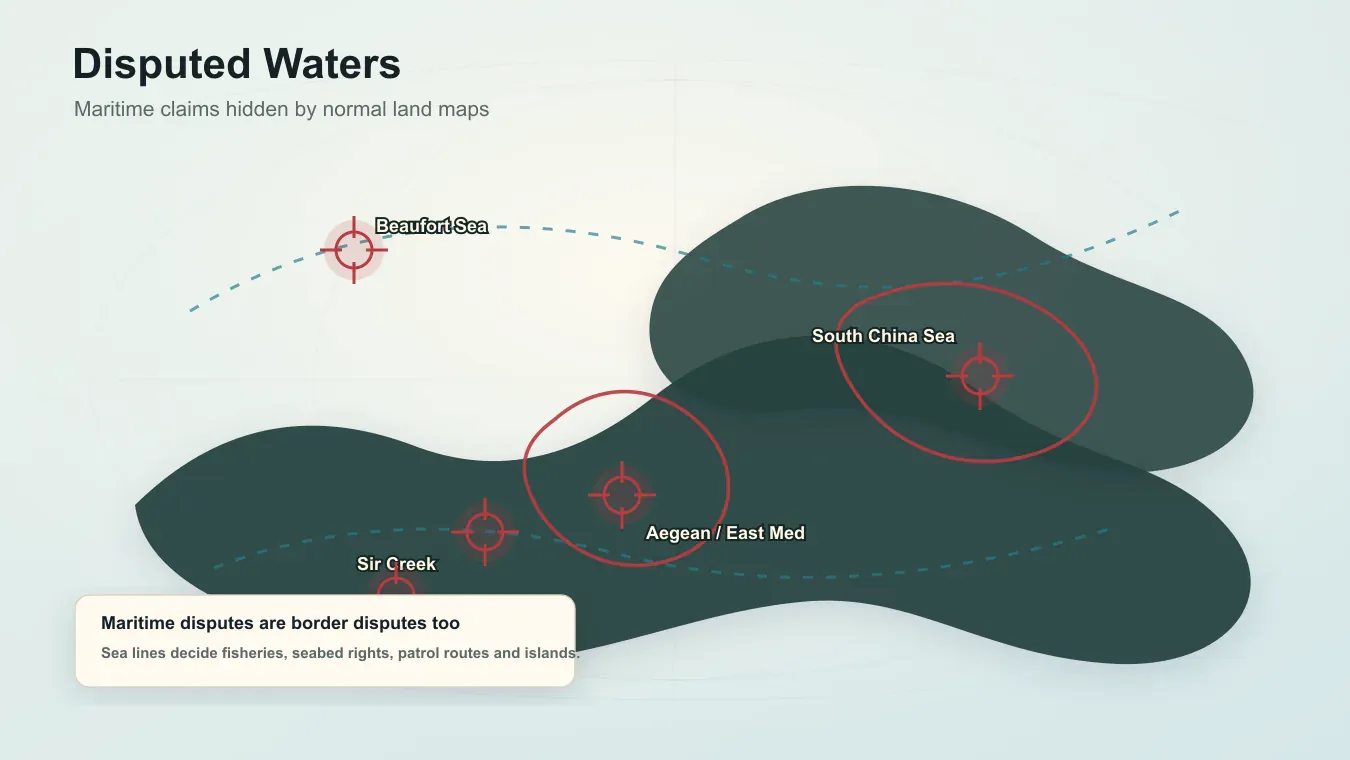
Many border disputes are at sea, where tiny features can shape huge maritime zones.
South China Sea
The South China Sea is the world's most complex maritime dispute. It involves China, Taiwan, Vietnam, the Philippines, Malaysia, Brunei and, around the Natuna area, Indonesia. The disputed features include the Spratly Islands, Paracel Islands, Scarborough Shoal, Second Thomas Shoal and many reefs, banks and rocks.
The 2016 South China Sea arbitration between the Philippines and China rejected major parts of China's maritime-rights argument under UNCLOS, but it did not decide sovereignty over every island and China rejected the award. (PCA award)
That is why the dispute continues: law clarified some maritime entitlements, but it did not create a political settlement accepted by all claimants.
The South China Sea is a sovereignty dispute and a daily patrol problem at the same time.
Greece, Turkey, Cyprus and the Eastern Mediterranean
The Aegean dispute between Greece and Turkey includes continental shelf, territorial waters, airspace, exclusive economic zones and sovereignty over some islets. Turkey's foreign ministry frames the continental shelf as one element of a wider set of Aegean disputes. (Turkish MFA)
The Eastern Mediterranean adds Cyprus, offshore gas, Turkey-Libya maritime understandings, Greek island entitlements and competing EEZ maps. This is not just a Greek-Turkish problem. It is a maritime-order problem.
Sir Creek
Sir Creek is small on a world map but large in legal effect. If India and Pakistan draw the creek boundary differently, the maritime endpoint changes, which changes access to seabed and fishing zones.
That is why some minor-looking river and estuary disputes matter more than their size suggests.
Beaufort Sea and other US-Canada disputes
The United States and Canada have one of the world's friendliest borders, but not a perfectly settled one. The Beaufort Sea maritime boundary remains unresolved enough that both governments announced a joint task force in 2024 to negotiate it. (US State Department)
Machias Seal Island and North Rock in the Gulf of Maine are also claimed by both sides. This is the low-temperature version of a border dispute: legally unresolved, politically managed, rarely dangerous.
Gulf of Fonseca
The Gulf of Fonseca touches El Salvador, Honduras and Nicaragua. The ICJ's 1992 Land, Island and Maritime Frontier Dispute settled major land and island questions, but the gulf's shared maritime character keeps it in the border-dispute conversation. (ICJ Fonseca)
Caribbean and South American maritime disputes
The Americas also have maritime and river disputes that rarely make global headlines:
- Colombia and Nicaragua have fought repeated legal battles over Caribbean maritime rights.
- Venezuela and Colombia have a long-running Gulf of Venezuela/Los Monjes maritime issue.
- Guyana and Suriname still have the New River Triangle/Tigri Area land dispute and related river-boundary sensitivities.
- Suriname and French Guiana have had boundary disagreements tied to river-source interpretation.
Quiet does not mean settled.
The ICJ docket: where border disputes become legal cases
The most visible legal disputes are the ones before the International Court of Justice.
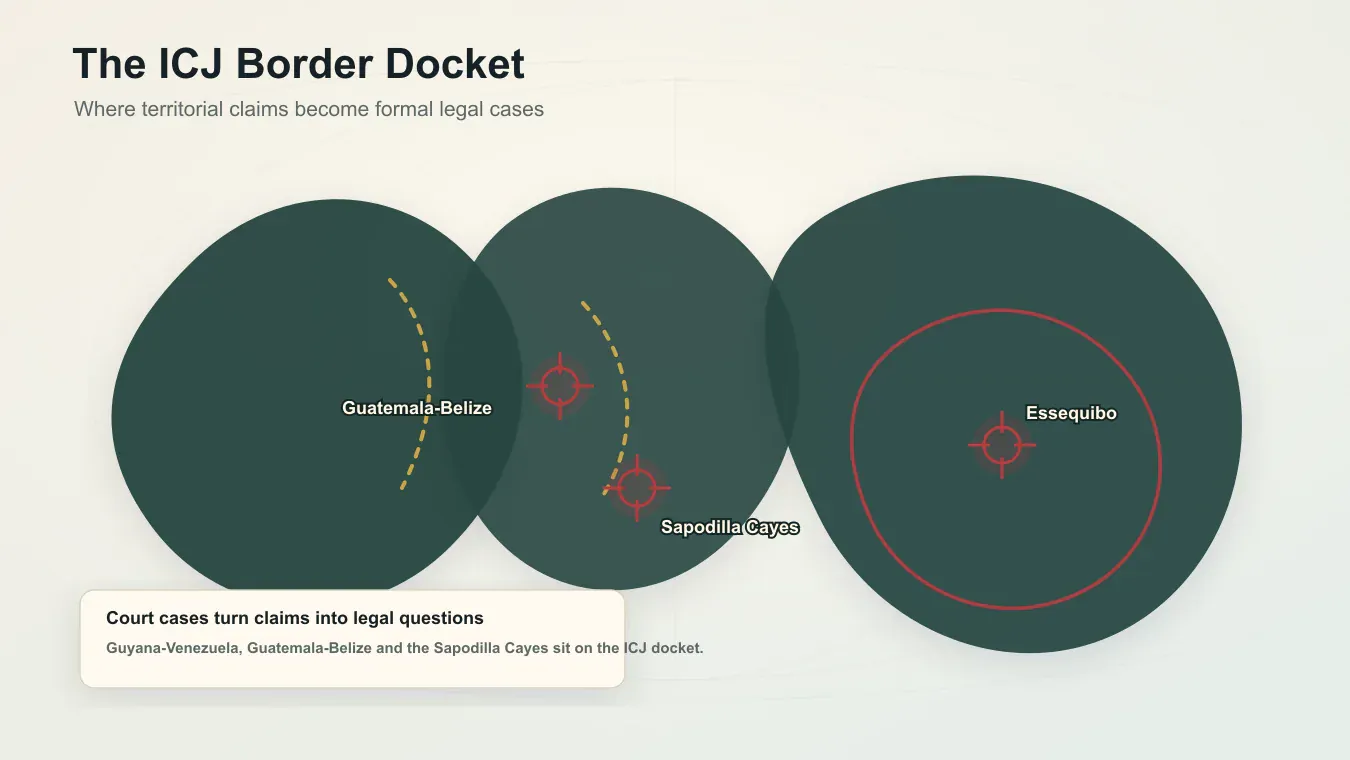
Court cases turn territorial claims into evidence, procedure and eventual implementation problems.
Guyana and Venezuela: Essequibo
The Essequibo dispute is one of the most important active territorial cases. Venezuela rejects the finality of the 1899 arbitral award that set the boundary with what became Guyana. Guyana asks the ICJ to confirm the award's validity. The ICJ listed public hearings on the merits for May 2026. (ICJ Guyana v. Venezuela)
This dispute matters because Essequibo is not a small border strip. It covers a huge part of Guyana's claimed territory and sits near major resource interests.
Guatemala and Belize
Guatemala's territorial, insular and maritime claim against Belize is another major live ICJ case. (ICJ Guatemala v. Belize) It is a rare modern example of a state asking the court to resolve a broad territorial claim over a neighbor's land and maritime space.
Belize, Honduras and Guatemala: Sapodilla Cayes
Belize also has a case against Honduras over sovereignty over the Sapodilla Cayes/Cayos Zapotillos, with Guatemala seeking intervention because of its own legal interest. (ICJ Belize v. Honduras)
The important lesson is that island disputes often create more than two-party problems. A caye can affect maritime boundaries for three states at once.
Recently decided cases
Some disputes should not be listed as fully active in the same way because courts have already ruled:
- Gabon-Equatorial Guinea: the ICJ delivered judgment in 2025 on land and maritime delimitation and sovereignty over islands. (ICJ Gabon/Equatorial Guinea)
- Costa Rica-Nicaragua: the ICJ ruled on Isla Portillos and maritime delimitation in 2018. (ICJ Isla Portillos)
- Cameroon-Nigeria: the Bakassi dispute was legally resolved by the ICJ and later implementation agreements, although local politics did not vanish overnight.
- Somalia-Kenya: the ICJ drew the maritime boundary in 2021; political acceptance and implementation remain separate questions.
Legal settlement is not instant social settlement. But it changes the category.
Europe and the Atlantic: old disputes, new politics
Europe's borders look stable, but several disputes remain.
Kosovo and Serbia
Kosovo declared independence in 2008 and is recognized by many states, but not by Serbia, Russia, China or the United Nations as a member state. UNMIK was established under Security Council Resolution 1244, which remains central to the legal status conversation. (UNMIK)
This is both a sovereignty dispute and a border dispute, because recognition determines whether the Serbia-Kosovo line is an international frontier or an internal administrative boundary.
Gibraltar
The United Kingdom controls Gibraltar. Spain claims sovereignty. The territory is on the UN list of non-self-governing territories, and the sovereignty question survives even when practical UK-EU-Spain border arrangements improve. (UN non-self-governing territories)
The Gibraltar lesson: daily border cooperation can improve without sovereignty being settled.
Falkland Islands, South Georgia and South Sandwich Islands
The United Kingdom administers the Falkland Islands. Argentina claims them as the Malvinas. Argentina also claims South Georgia and the South Sandwich Islands. The UN non-self-governing-territory system keeps the Falklands question institutionally alive, while the UK points to islander self-determination. (UN non-self-governing territories)
This is a sovereignty dispute with a war in living memory and a referendum in recent memory.
Slovenia and Croatia
Slovenia and Croatia remain divided over parts of their land and maritime boundary, especially Piran Bay, after Croatia rejected an arbitration process that Slovenia accepts.
Croatia and Serbia
Croatia and Serbia disagree over parts of the Danube boundary, where the river's historical course and current course produce different claims to islands and riverbank land.
Spain and Morocco
Spain controls Ceuta, Melilla and smaller plazas de soberania on the North African coast. Morocco rejects the permanence of Spanish sovereignty over these enclaves, even though the dispute is usually managed below the level of open military confrontation.
Africa: decolonization did not end every border dispute
Africa has many settled borders because postcolonial states generally preserved inherited colonial boundaries to avoid endless revision. But several important disputes remain.
UN-monitored and decolonization disputes can stay quiet without becoming settled.
Western Sahara
Western Sahara is the clearest unresolved decolonization dispute. Morocco controls most of the territory. The Polisario Front claims self-determination and independence through the Sahrawi Arab Democratic Republic. MINURSO was created to monitor the ceasefire and support a referendum process that has never been completed. (MINURSO)
Western Sahara is not just a border dispute. It is a dispute over status, sovereignty, self-determination and regional security.
Egypt and Sudan: Halaib Triangle
Egypt controls the Halaib Triangle. Sudan claims it. Bir Tawil, nearby, is often mentioned because neither state wants to claim it in a way that would weaken its Halaib position. Halaib is the real dispute; Bir Tawil is the cartographic side effect.
Ethiopia and Sudan: Al-Fashaga
Al-Fashaga is a fertile borderland claimed and used in different ways by Sudanese and Ethiopian actors. It has become more volatile because both countries have faced internal conflict and state-capacity stress.
Eritrea and Djibouti
Ras Doumeira and Doumeira Island remain disputed between Eritrea and Djibouti. This is a small area with outsized strategic significance near the Red Sea and Bab el-Mandeb system.
Kenya, South Sudan and Ethiopia: Ilemi Triangle
The Ilemi Triangle is claimed or affected by Kenya, South Sudan and Ethiopia. It is a pastoral frontier where colonial-era ambiguity, local movement and state security all overlap.
Malawi and Tanzania: Lake Malawi/Lake Nyasa
Malawi claims the boundary runs along the Tanzanian shore under colonial-era treaty interpretation. Tanzania argues for a median-line approach in the lake. RUSI describes the dispute as still slipping in limbo. (RUSI)
This is a good example of a border dispute where water, fisheries, oil speculation and colonial drafting all meet.
Uganda and Kenya: Migingo Island
Migingo Island in Lake Victoria is tiny, but fishing rights make it politically sensitive. Kenya and Uganda have both had administrative and policing disputes around it.
Comoros and France: Mayotte
Mayotte is administered by France as an overseas department. Comoros claims it as part of the Comorian archipelago. The dispute is a decolonization question, a migration question and a domestic French political question at the same time.
Madagascar, Mauritius and France: Scattered Islands and Tromelin
Madagascar claims the French-administered Scattered Islands in the Indian Ocean. Mauritius has claimed Tromelin. These are island disputes whose importance lies less in population than in maritime zones, fisheries, environmental management and seabed rights.
UK and Mauritius: Chagos
The Chagos dispute has moved but not disappeared. The ICJ's 2019 advisory opinion said the UK's continued administration of the Chagos Archipelago had legal consequences for decolonization. (ICJ Chagos) A 2025 UK-Mauritius treaty would transfer sovereignty to Mauritius while preserving UK rights on Diego Garcia, but the treaty was described as not yet in force in the parliamentary material and remains politically sensitive. (UK Parliament)
Burkina Faso and Benin: Kourou/Koalou
Kourou/Koalou is a small disputed zone near the Benin-Burkina Faso-Togo area. It is a reminder that not every border dispute is famous. Some become security problems because unclear sovereignty creates weak administration.
Asia-Pacific: the densest cluster of island and maritime disputes
Asia has the world's highest concentration of border disputes that combine nationalism, energy, fisheries and military risk.
Taiwan and China
The People's Republic of China claims Taiwan. Taiwan governs itself. Many states maintain unofficial relations with Taiwan while recognizing Beijing diplomatically. This is a sovereignty dispute, not a normal border dispute, but any conflict would immediately become a dispute over the international map.
Korean Peninsula
North Korea and South Korea are separated by the Demilitarized Zone, but the Korean War ended with an armistice, not a peace treaty. The Northern Limit Line in the Yellow Sea is also contested by North Korea.
This is a frozen-war boundary. It is stable until it is not.
Senkaku/Diaoyu/Diaoyutai
Japan administers the Senkaku Islands. China claims them as Diaoyu. Taiwan also claims them as Diaoyutai. Japan's foreign ministry rejects the existence of a sovereignty dispute, while China and Taiwan reject Japan's position. (Japan MOFA Senkaku)
Dokdo/Takeshima
South Korea administers Dokdo. Japan claims the islands as Takeshima. Japan's foreign ministry says it will seek settlement under international law, while South Korea's official Dokdo materials present the islands as Korean territory. (Japan MOFA Takeshima) (Korea Dokdo)
This dispute is small geographically and large emotionally.
Kurils/Northern Territories
Russia controls the southern Kurils. Japan claims Etorofu, Kunashiri, Shikotan and the Habomai islets as the Northern Territories. Japan's foreign ministry says the attribution of the four islands remains to be resolved before a peace treaty. (Japan MOFA Northern Territories)
This is why Japan and Russia still have no final World War II peace treaty.
Iran and the UAE: Abu Musa, Greater Tunb and Lesser Tunb
Iran controls Abu Musa and the Greater and Lesser Tunbs. The UAE claims them and calls for settlement through negotiation or the ICJ. The UAE Embassy describes the islands as occupied Emirati islands. (UAE Embassy)
The islands matter because they sit near the Strait of Hormuz, one of the world's strategic chokepoints.
China and Bhutan
China and Bhutan do not have a fully demarcated border. Disputed sectors include western and northern areas, with Doklam especially sensitive because of India's security concerns near the Siliguri Corridor.
India and Nepal
India and Nepal disagree over Kalapani, Lipulekh and Limpiyadhura, and also over Susta. The issue returned to public attention again in 2026 as Nepalese political actors revived the claim. (Al Jazeera)
This is a border dispute between friendly, open-border neighbors, which makes it less explosive but still politically potent.
Philippines and Malaysia: Sabah
The Philippines has a dormant but recurring claim linked to Sabah, now a Malaysian state. It does not dominate daily diplomacy, but it returns during legal and maritime controversies.
Vanuatu and France: Matthew and Hunter Islands
Vanuatu claims Matthew and Hunter Islands. France administers them through New Caledonia. Like many Pacific island disputes, the real map is maritime: reefs and islets can generate large ocean claims.
Fiji and Tonga: Minerva Reefs
Fiji and Tonga have disputed the Minerva Reefs. Tonga controls them, while Fiji has objected. The stakes are less population than maritime space.
Marshall Islands and the United States: Wake Island
Wake Island is administered by the United States. The Marshall Islands has historically asserted a claim. It is a low-temperature dispute, but it belongs on any broad inventory of unresolved island claims.
Americas: fewer wars, many unfinished lines
The Americas have fewer active border wars than some regions, but several disputes remain.
Venezuela and Guyana
Essequibo is the hemisphere's most serious active territorial dispute. It is before the ICJ, tied to oil, identity and national survival narratives, and capable of becoming a regional security crisis. (ICJ Guyana v. Venezuela)
Guatemala and Belize
Guatemala's claim against Belize is also before the ICJ. It involves land, islands and maritime rights, and it is one of the few remaining large territorial disputes in Central America. (ICJ Guatemala v. Belize)
Belize, Honduras and Guatemala
The Sapodilla Cayes case shows how Belize's maritime edge can affect Honduras and Guatemala at once. (ICJ Belize v. Honduras)
Guyana and Suriname
The New River Triangle, also called the Tigri Area, remains disputed between Guyana and Suriname. The core question is which river source defines the boundary.
Chile and Argentina
Chile and Argentina settled many serious disputes, but the Southern Patagonian Ice Field still has an undefined or differently represented section. Glaciers make demarcation more than a map exercise.
Peru and Chile
The maritime boundary was resolved at the ICJ, but a small terrestrial triangle near the coast remains politically sensitive in some national maps and statements.
Haiti and the United States: Navassa Island
The United States administers Navassa Island as a wildlife refuge. Haiti claims it. It is another low-temperature island dispute with maritime implications.
United States and Canada
The US-Canada disputes are managed, not solved:
- Beaufort Sea maritime boundary
- Machias Seal Island and North Rock
- Dixon Entrance and other technical maritime disagreements
The key lesson is that allies can carry unresolved borders for generations when the cost of fighting is obviously higher than the value of settlement.
Recently resolved disputes that should not be mislisted as active
A strong border article should not inflate the list by pretending old disputes are still current at the same level.
These are better described as resolved, largely resolved or in implementation:
- Kyrgyzstan-Tajikistan: the United States congratulated both countries in 2025 on an agreement to delineate and demarcate the entirety of their border. (US State Department)
- Gabon-Equatorial Guinea: the ICJ delivered judgment in 2025. (ICJ Gabon/Equatorial Guinea)
- Costa Rica-Nicaragua: the ICJ settled the northern Isla Portillos boundary issue in 2018. (ICJ Isla Portillos)
- Cameroon-Nigeria Bakassi: legally settled by the ICJ, with implementation through later agreements.
- Ecuador-Peru: settled by the 1998 peace agreement.
- Qatar-Bahrain: settled by the ICJ in 2001.
- Denmark-Canada Hans Island: settled in 2022.
- Bolivia-Chile access to the Pacific: politically alive in Bolivia, but the ICJ ruled in 2018 that Chile had no legal obligation to negotiate sovereign access.
Resolved does not mean forgotten. It means the legal category changed.
Why these disputes survive
Most border disputes survive for one of six reasons.
1. The line was never clearly drawn
Many disputes began with vague colonial texts, poor surveys, shifting rivers, imprecise maps or contradictory administrative documents. Kourou/Koalou, Tigri/New River Triangle, Southern Patagonian Ice Field and parts of the Malawi-Tanzania lake dispute fit this pattern.
2. The line was drawn, but one side rejects the result
Essequibo, Preah Vihear, South China Sea maritime entitlements and some ICJ-decided disputes show this problem. A judgment can clarify law without ending political rejection.
3. Control and law diverge
This is the hardest category. Crimea, parts of eastern and southern Ukraine, Abkhazia, South Ossetia, Northern Cyprus, Golan, Western Sahara and parts of the occupied Palestinian territory all involve a mismatch between control and international recognition.
4. Maritime rights made tiny places valuable
An islet, reef or rock can affect fisheries, oil, gas, seabed mining, patrol routes and military basing. That is why Dokdo/Takeshima, Senkaku/Diaoyu, Abu Musa, the Tunbs, Minerva Reefs, Matthew and Hunter Islands, and the Sapodilla Cayes matter.
5. Domestic politics rewards refusal
Borders are identity symbols. Leaders can lose more at home by compromising than they gain abroad by settling. That is why some disputes stay frozen even when the material stakes are small.
6. A temporary line became permanent in practice
Ceasefire lines, buffer zones and administrative boundaries can last so long that people start treating them as borders. Kashmir, Cyprus, Korea, Kosovo, Georgia's breakaway regions and the Golan all show the danger: a temporary security line can become the lived geography of generations.
The practical way to read any disputed border
When a border dispute appears in the news, ask six questions before deciding how serious it is.
- Who controls the territory today?
- Who claims it legally?
- Is the dispute over land, sea, islands, airspace or status?
- Has a court, treaty or arbitration already decided any part of it?
- Is there a UN mission, ceasefire line or demilitarized zone?
- Would settlement change resources, military access, identity politics or only map symbolism?
That framework prevents two common mistakes.
The first mistake is treating every dispute as a coming war. Most are not.
The second mistake is treating every quiet dispute as irrelevant. Some quiet disputes sit next to oil fields, chokepoints, nuclear states or unresolved wars.
The takeaway
The world map is not blank chaos. Most borders are settled enough to run daily life.
But the map is also not finished.
In 2026, the most dangerous disputes are not always the most obscure. Ukraine, Kashmir, the India-China border, the South China Sea, Israel-Palestine, Western Sahara, Abyei and Essequibo all show how old territorial questions can shape current security, energy, migration, trade and diplomacy.
The deeper lesson is simpler.
A border is not just a line. It is a claim backed by law, memory, administration, force, recognition and habit.
When all of those line up, the border feels natural.
When they do not, the map starts to move.
FAQ
How many country borders are disputed in 2026?
There is no single official global count. A defensible broad inventory includes several dozen active disputes if you count land borders, occupied territories, disputed islands and maritime boundaries. The number changes depending on whether you include dormant claims, legally decided disputes under political protest, and non-self-governing territories.
What is the most dangerous disputed border in the world?
The Russia-Ukraine front is the most active war over territory. India-Pakistan and India-China are especially dangerous because they involve nuclear-armed states. The South China Sea is dangerous because several states, major shipping routes and military forces overlap in a confined maritime space.
What is the biggest current territorial dispute by area?
Western Sahara and Essequibo are among the largest unresolved territorial disputes by land area. Ukraine's occupied territories are also among the most consequential because they involve a major interstate war and attempted annexation.
Are maritime disputes really border disputes?
Yes, when they determine territorial seas, exclusive economic zones, continental shelves, seabed rights or island sovereignty. Modern borders often extend into the sea, and maritime disputes can affect fishing, hydrocarbons, naval access and strategic chokepoints.
Which border disputes are before the International Court of Justice?
Major ICJ-linked disputes include Guyana v. Venezuela over the 1899 arbitral award, Guatemala v. Belize, and Belize v. Honduras over the Sapodilla Cayes, with Guatemala intervening. Other cases have recently been decided, including Gabon v. Equatorial Guinea.
Are all disputed borders likely to cause wars?
No. Many are managed peacefully for decades. US-Canada, Gibraltar, Falklands/Malvinas, Dokdo/Takeshima and the Southern Patagonian Ice Field are politically sensitive but not comparable to active war zones. Risk depends on military posture, domestic politics, resources, alliances and whether a crisis gives leaders incentives to escalate.
Why do tiny islands create big disputes?
Tiny islands can affect huge maritime zones. They also carry national symbolism. A rock with no ordinary economic life can still matter if it changes fishing access, seabed claims, military monitoring or historical legitimacy.
Which disputes were recently resolved?
Kyrgyzstan and Tajikistan reached a full border agreement in 2025. Hans Island was settled by Canada and Denmark in 2022. Several ICJ cases, including Gabon-Equatorial Guinea and Costa Rica-Nicaragua, have moved from active legal dispute to implementation and political acceptance.